AI business automation is becoming one of the most useful skills for small business owners, digital marketers, project managers, and agency teams. I am learning AI business automation step by step, not only to understand AI tools but also to apply them in real business workflows.
This article is the beginning of my AI learning journey on sadedar.com. My goal is simple: I want to learn AI by practicing it, documenting it, and publishing useful blog posts that can help other business owners, marketers, and small agency teams.
AI is not only for large companies. Small and medium-sized businesses can also use AI to improve lead follow-up, CRM updates, SEO planning, customer support, reporting, and internal task management. However, AI should be used with a clear plan, proper human review, and a focus on business results.
In this guide, I will explain how I am learning AI for business automation, what skills I plan to build, what tools I want to explore, and how this learning journey can help small businesses in the future.
Why I Am Learning AI Business Automation
Artificial intelligence is changing how businesses manage daily work. However, many small businesses still do not know where to start.
Some business owners think AI is too technical. Others think AI is only useful for writing content. In reality, AI can help with many practical business tasks, such as:
- Writing better client emails
- Summarizing meetings
- Creating task lists
- Drafting SEO reports
- Planning blog topics
- Organizing customer questions
- Improving CRM follow-up
- Supporting chatbot conversations
- Creating automation workflows
As someone involved in digital marketing, web projects, SEO, CRM, and business process planning, I see AI as a practical skill that can improve both internal agency operations and client services.
Therefore, I am not learning AI only as a trend. I am learning it as a business skill.
My Main Goal: Practical AI, Not Just Theory
There are many AI courses, tutorials, and videos online. However, learning without implementation does not create real value.
So, my approach is different.
I want to learn AI by building useful workflows and documenting each step. Instead of only reading about AI, I will test prompts, compare tools, create templates, build automations, and publish what I learn.
My learning process will focus on three things:
- Understand the concept clearly
- Apply it to a real business task
- Document the result as a helpful blog post
This will help me learn faster. At the same time, it will help readers understand how AI can be used in practical business situations.
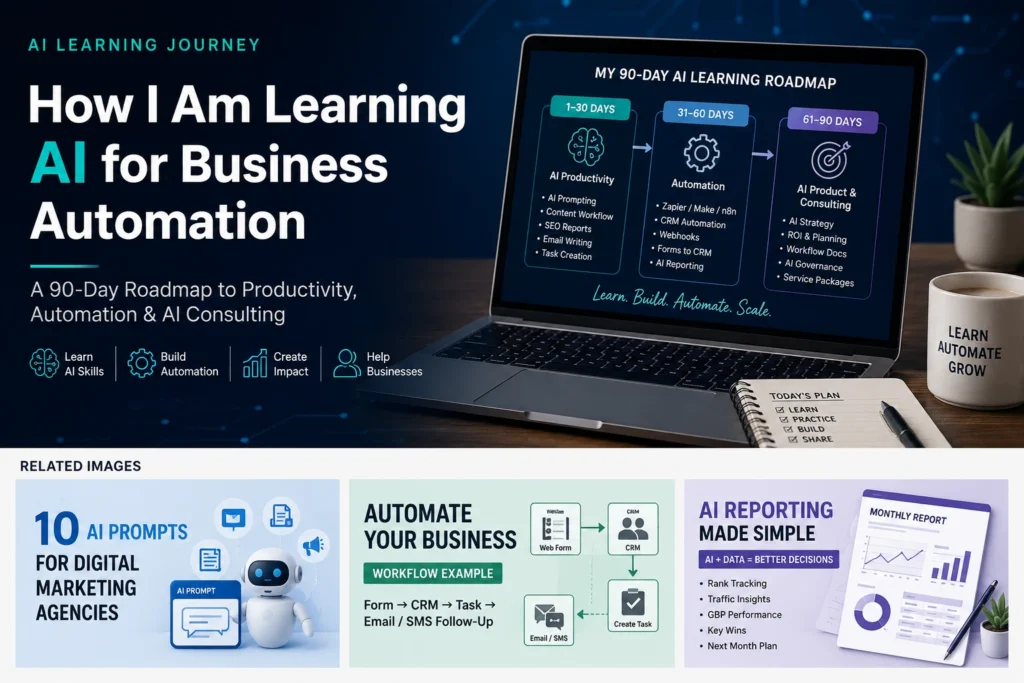
My 90-Day AI Learning Roadmap
I am dividing my AI learning journey into three major phases.
Each phase has a clear focus. First, I will learn AI productivity. Next, I will learn automation. Finally, I will learn AI product planning and consulting.
This step-by-step structure will help me avoid confusion and build skills in the right order.
Phase 1: First 30 Days — AI Productivity
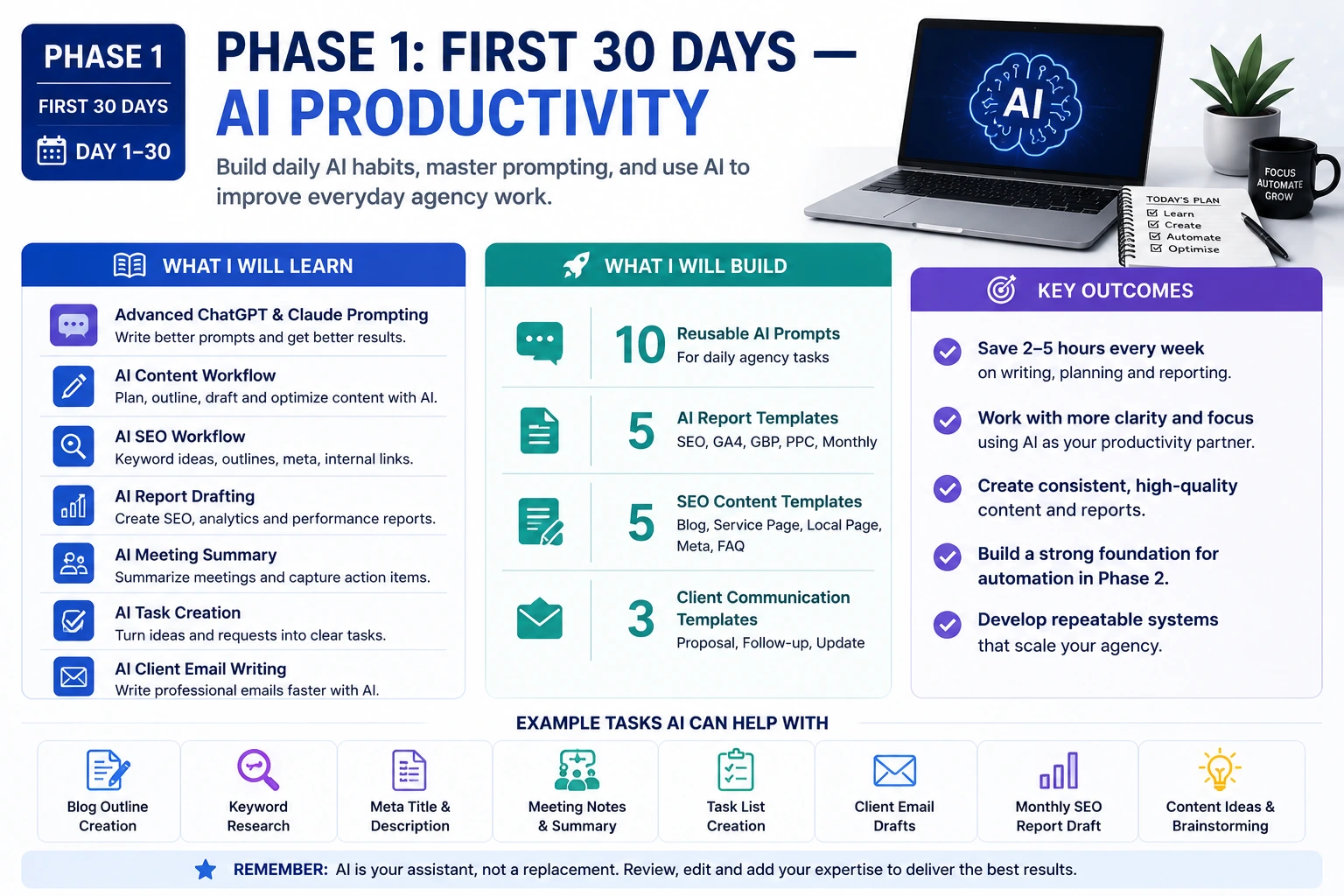
The first 30 days will focus on AI productivity.
This means I will use AI to improve daily work. Before building advanced automations, I need to understand how AI can help with thinking, writing, planning, summarizing, and organizing work.
What I Plan to Learn in the First 30 Days
During this phase, I will focus on:
- Advanced ChatGPT and Claude prompting
- AI content workflow
- AI SEO workflow
- AI report drafting
- AI meeting summaries
- AI task creation
- AI client email writing
These are practical skills that can be used every day in a digital agency or small business.
For example, AI can help draft a client email, but a human should still review the tone, accuracy, and final message. Similarly, AI can help prepare an SEO report draft, but the final report should be checked with real data.
What I Plan to Build in the First 30 Days
By the end of this phase, I want to create:
- 10 reusable prompts for agency work
- 5 SEO report templates
- 5 SEO content templates
- 3 client communication templates
These templates will help me save time and create more consistent work.
Blog Topics I Will Publish in This Phase
Some of the topics I plan to write include:
- What Is AI Business Automation?
- How to Write Better AI Prompts for Business Tasks
- 10 Reusable AI Prompts for Digital Marketing Agencies
- How to Use AI for Client Email Writing
- How to Use AI for Monthly SEO Report Drafting
- How to Humanize AI-Written Content for Better Trust
This phase will create the foundation for my AI productivity system.
Phase 2: Next 60 Days — AI Automation
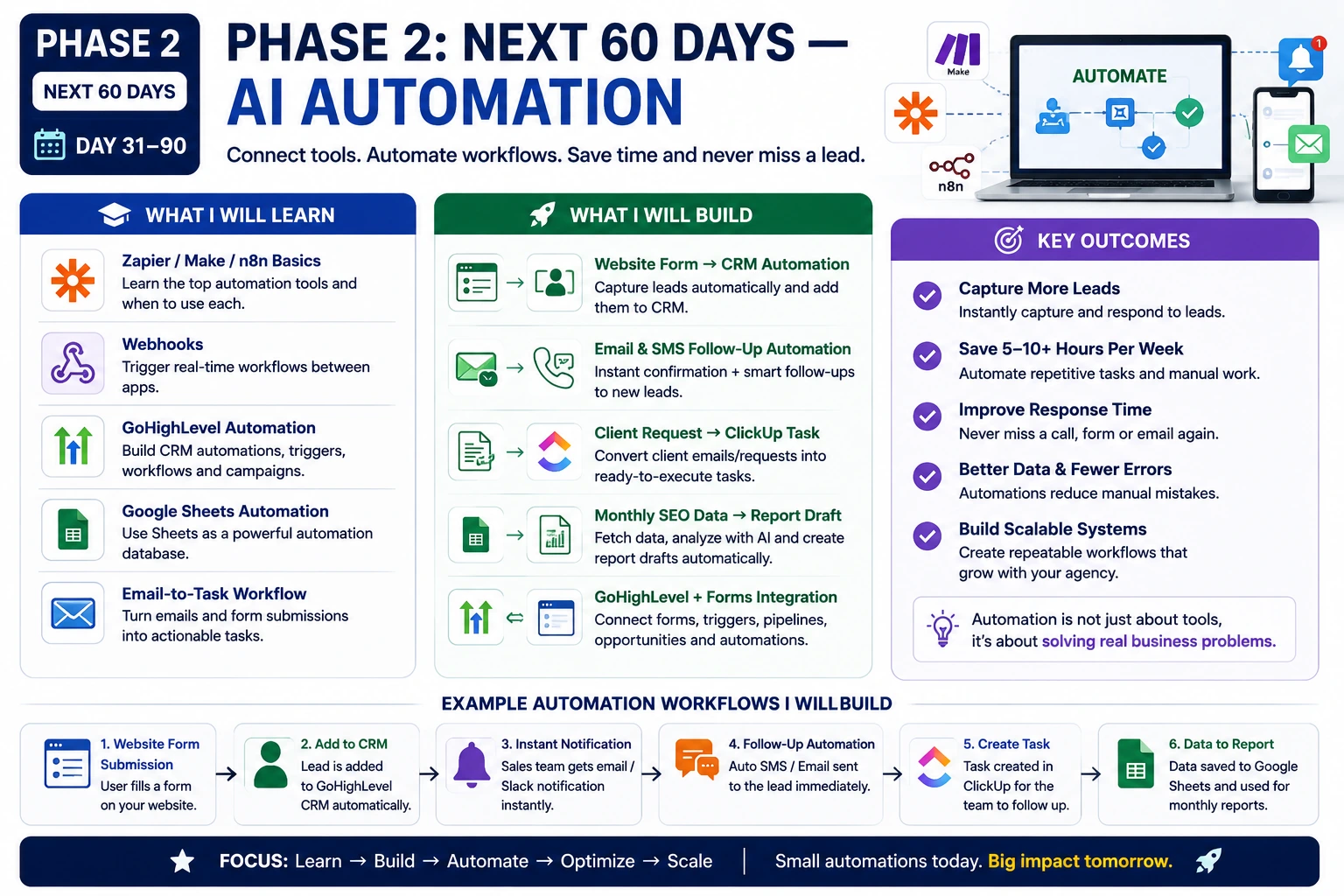
After learning AI productivity, I will move into AI automation.
This is where AI becomes more powerful. Instead of using AI only for one task at a time, automation connects different tools and creates repeatable workflows.
For example, a website form can collect a lead, send the lead to a CRM, notify the sales team, create a task, and send an automatic follow-up message.
That type of workflow can save time and reduce missed opportunities.
What I Plan to Learn in the Automation Phase
During this phase, I will study:
- Zapier
- Make
- n8n
- GoHighLevel automation
- Webhooks
- Google Sheets automation
- Email-to-task workflow
These tools are important because many small businesses already use forms, CRMs, emails, spreadsheets, and task management systems. AI automation can connect these systems more intelligently.
What I Plan to Build in This Phase
My goal is to build practical workflows such as:
- Website form to CRM automation
- Website form to email and SMS follow-up
- Client request to ClickUp task automation
- Monthly SEO data to report draft automation
- Google Sheets-based tracking workflow
These workflows can be used inside an agency. Later, they can also become service packages for clients.
Why Automation Matters for Small Businesses
Many small businesses lose leads because they reply too late. A customer may submit a form, call after business hours, or ask a question online. If there is no quick response, the customer may contact another company.
Automation can help by:
- Sending instant confirmation messages
- Notifying the right team member
- Creating follow-up reminders
- Updating CRM records
- Reducing manual data entry
- Improving response speed
However, automation should not replace human relationships. Instead, it should support the team and make sure important tasks are not missed.
Phase 3: Next 90 Days — AI Product and Consulting Skills
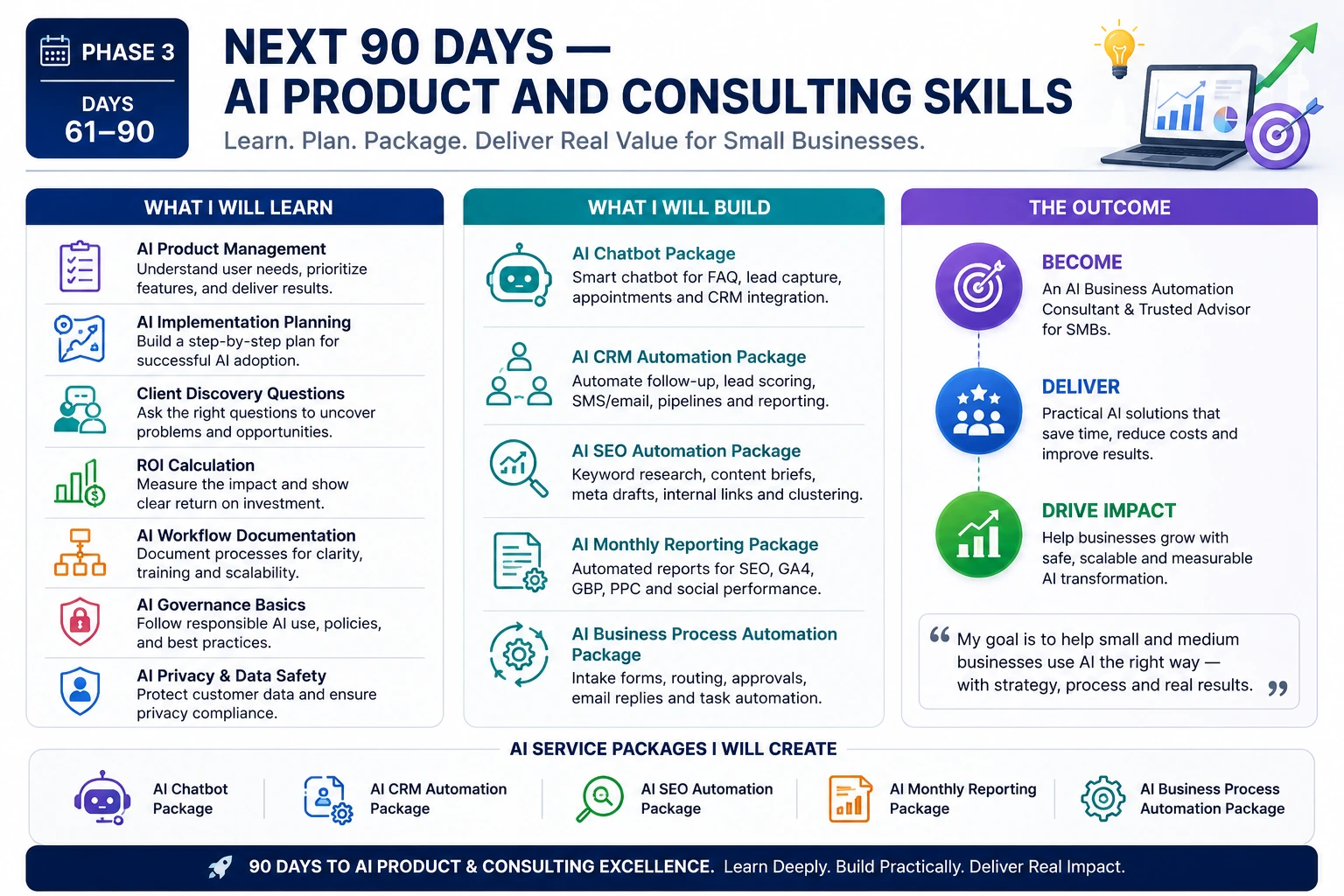
The final phase of my roadmap will focus on AI product planning and consulting.
At this stage, I want to learn how to help businesses adopt AI in a structured way. This includes understanding their current workflow, identifying automation opportunities, calculating ROI, and planning safe implementation.
What I Plan to Learn in This Phase
I will focus on:
- AI product management
- AI implementation planning
- Client discovery questions
- ROI calculation
- AI workflow documentation
- AI governance basics
- AI privacy and data safety
This phase is important because AI is not only about tools. Businesses also need strategy, process, privacy, and measurement.
What I Plan to Build in This Phase
By the end of this phase, I want to create AI service packages such as:
- AI chatbot package
- AI CRM automation package
- AI SEO automation package
- AI monthly reporting package
- AI business process automation package
These packages can help small businesses understand what they are buying and what results they can expect.
What AI Business Automation Means to Me
AI business automation means using artificial intelligence and automation tools to reduce repetitive work, improve communication, and make business operations more efficient.
It is not about replacing people.
Instead, it is about helping people work better.
For example:
- A project manager can use AI to summarize client requests.
- A marketer can use AI to create blog outlines faster.
- A sales team can use automation to follow up with leads.
- A clinic can use an AI chatbot to answer common questions.
- A local service business can use AI to organize customer inquiries.
When used correctly, AI can support the team, improve customer experience, and reduce operational pressure.
Tools I Want to Learn and Test
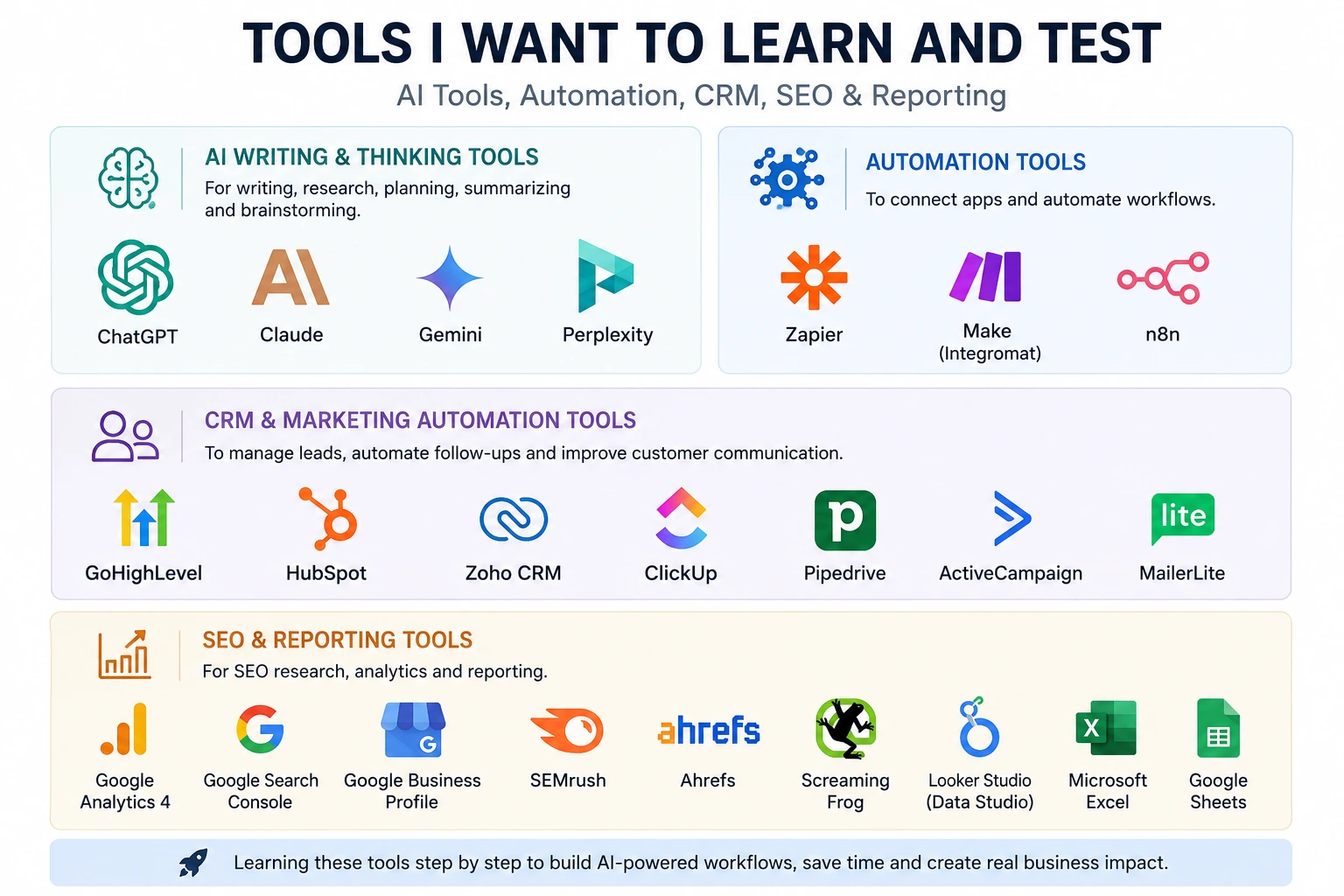
My AI learning journey will include different types of tools.
AI Writing and Thinking Tools
These tools help with writing, planning, summarizing, and brainstorming.
Examples include:
- ChatGPT
- Claude
- Gemini
- Perplexity
I will use these tools for prompts, reports, emails, content planning, and research support.
Automation Tools
These tools connect apps and automate workflows.
Examples include:
- Zapier
- Make
- n8n
I want to understand which tool is best for different business needs.
CRM and Marketing Automation Tools
These tools help businesses manage leads and follow-up.
Examples include:
- GoHighLevel
- HubSpot
- Zoho CRM
- ClickUp
Since many small businesses struggle with follow-up, CRM automation will be an important part of my learning.
SEO and Reporting Tools
AI can also support SEO and reporting work.
For example, AI can help summarize:
- Keyword ranking changes
- Google Analytics data
- Google Business Profile performance
- Paid ad performance
- Monthly marketing activities
However, AI should not invent data. Real numbers must come from trusted tools, and AI should only help organize and explain them.
How I Will Use AI for SEO and Content
AI can be useful for SEO, but it must be used carefully.
Low-quality AI content can hurt trust. Therefore, my goal is not to publish generic AI-written articles. Instead, I want to use AI as a planning and drafting assistant.
My SEO content workflow will include:
- Research the topic
- Understand the reader’s problem
- Create a useful outline
- Draft the article with AI support
- Add personal experience and examples
- Check accuracy
- Improve readability
- Add internal links
- Add FAQs
- Review before publishing
This process will help me create better content while avoiding thin or low-value posts.
My AI Learning Method
I will follow a simple learning method for every topic.
Step 1: Learn the Basic Concept
First, I will understand the topic in simple language.
For example, before using webhooks, I need to understand what a webhook is and why businesses use it.
Step 2: Test the Tool or Workflow
Next, I will test the tool in a practical way.
For example, I may test how a website form sends data to a CRM.
Step 3: Create a Template or Checklist
After testing, I will create a reusable template, prompt, or checklist.
This will make the learning useful for future work.
Step 4: Publish a Blog Post
Finally, I will publish the lesson as a blog post on sadedar.com.
This will help me remember what I learned and help others who are trying to understand AI automation.
Who Can Benefit From This AI Learning Series?
This blog series will be useful for:
- Small business owners
- Digital marketers
- Project managers
- SEO professionals
- Web design agencies
- CRM managers
- Local service businesses
- Freelancers
- Startup teams
The content will focus on practical business use cases instead of complex technical theory.
Example: How a Small Business Can Use AI Automation
Let’s imagine a local roofing company receives leads from its website.
Without automation, the process may look like this:
- Customer fills out a form
- Email goes to the office
- Someone checks the email later
- Salesperson manually calls the customer
- Follow-up may or may not happen
With AI business automation, the process can improve:
- Customer fills out a form
- Lead is added to the CRM
- Sales team gets a notification
- Customer receives an instant SMS or email
- Follow-up task is created automatically
- AI helps summarize the customer request
- Manager can track lead status
This type of system can reduce missed leads and improve response time.
My Long-Term Goal
My long-term goal is to become better at using AI for practical business transformation.
I want to build skills in:
- AI prompting
- Workflow design
- CRM automation
- SEO automation
- AI chatbot planning
- Business process automation
- AI reporting systems
- AI implementation planning
Over time, this learning journey can support a larger goal: helping small and medium-sized businesses adopt AI in a practical, secure, and measurable way.
Common Mistakes I Want to Avoid
As I learn AI, I also want to avoid common mistakes.
Mistake 1: Using AI Without a Clear Goal
AI should solve a real business problem. It should not be used only because it is popular.
Mistake 2: Publishing AI Content Without Review
AI can make mistakes. Therefore, every article, report, or email should be reviewed before use.
Mistake 3: Automating a Broken Process
Automation works best when the process is already clear. If the workflow is confusing, automation can make the problem worse.
Mistake 4: Ignoring Privacy and Data Safety
Businesses should be careful when sharing customer data, medical information, financial details, or private documents with AI tools.
Mistake 5: Replacing Human Judgment
AI can support decision-making, but humans should remain responsible for strategy, ethics, and final approval.
FAQs About My AI Business Automation Learning Journey
What is AI business automation?
AI business automation means using AI tools and automation systems to complete repetitive business tasks faster. It can help with lead follow-up, reporting, customer support, CRM updates, email writing, task creation, and content planning.
Is AI only useful for large companies?
No. Small businesses can also use AI. In fact, small businesses may benefit greatly because AI can help them save time, respond faster, and reduce manual work.
Can AI replace employees?
AI should not be viewed only as a replacement for people. In many cases, AI works best as a support tool that helps employees work faster and more consistently.
What should small businesses automate first?
Small businesses should usually start with simple workflows, such as lead follow-up, missed-call text-back, appointment requests, email reminders, and CRM updates.
Why am I publishing my AI learning journey?
I am publishing this journey to learn in public, document practical workflows, and help other business owners, marketers, and agency teams understand how AI can be used in real work.
Final Thoughts
AI business automation is not a one-day skill. It requires step-by-step learning, testing, documentation, and improvement.
My plan is to start with AI productivity, then move into automation, and finally build AI consulting and implementation skills. This journey will help me understand how AI can support real business operations, especially for small and medium-sized businesses.
This is the first article in my AI learning series on sadedar.com. In the next article, I will explain what AI business automation is and how small businesses can start using it without feeling overwhelmed.
Want to learn AI with me step by step? Follow this AI business automation series on sadedar.com, and start by choosing one simple task in your business that AI can help improve this week.